
Returning to the UK as a Dentist: Understanding Your Options


For UK students studying dentistry in Bulgaria, returning home to practise can feel unclear. There is no single “correct” route — but there are recognised pathways depending on your timing, confidence, and career goals.
This page explains the main return routes, what they involve, and how to choose the right one for you.
Important:
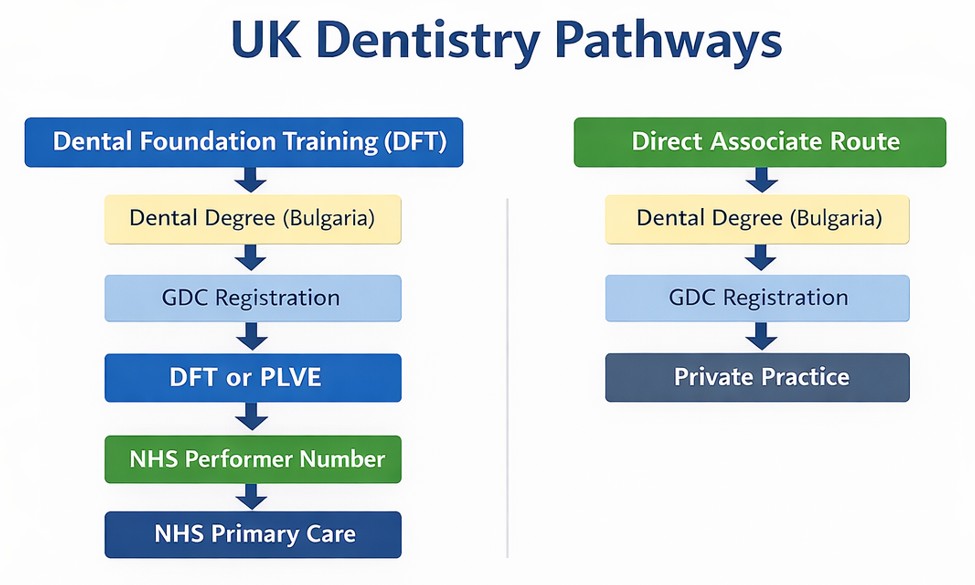
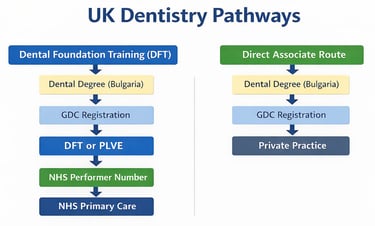
To work in NHS primary care, dentists must hold an NHS Performer Number, usually obtained through Dental Foundation Training (DFT) or PLVE. Once a Performer Number is obtained, dentists may work in NHS, mixed, or private practice. Without a Performer Number, practice is limited to private roles only.
The Two Main Return Pathways


Key features
Fixed-term training year
Educational supervision
Formal study days
Competitive application process
Limited places
1. Dental Foundation Training (DFT)
Dental Foundation Training is a structured, supervised year designed to support newly qualified dentists transitioning into UK practice and who may want to work in NHS primary care.
Things to consider
Applications are time-sensitive
Not all overseas-trained graduates secure places
May delay entry into full earnings
DFT can be an excellent option for those who prefer structure and formal support, but it is not compulsory for all returning graduates.


Key features
Faster entry into work
Private, or mixed practices (including NHS although subject to having an NHS Performer Number first)
Learning occurs on the job
Requires strong practice support
2. Direct Associate Route
Many graduates returning from Bulgaria enter UK dentistry as associate dentists without completing DFT, as they are not currently interested in working in NHS primary care.
Things to consider
Quality of supervision varies by practice
Contract terms matter significantly
Early choices can shape long-term confidence
This route is common and legitimate, but success depends heavily on choosing the right practice.
NHS vs Private
Early in Your Career
Structured patient flow
UDA-based targets
Good exposure to volume dentistry
Requires understanding of NHS systems
NHS roles


V
Private roles
Slower pace initially
Greater emphasis on communication
Income varies more
Often better mentoring in smaller practices


NHS Performer Number & Eligibility
To practise dentistry anywhere in the UK — private or NHS — you must be fully registered with the General Dental Council (GDC). However, GDC registration alone does not allow you to treat NHS patients in primary care. To work on the NHS, you must also be included on an official NHS Dental Performers List and have a Performer Number.
Most newly qualified dentists obtain a Performer Number by completing Dental Foundation Training (DFT), which includes supervised clinical experience and entry onto the Performers List. Another route for experienced dentists is Performer List Validation by Experience (PLVE), which assesses clinical competence based on previous practice and often used by overseas-trained dentists.
If you are not on a Performers List, you can still work as a dentist in private practice, but you cannot provide NHS primary care services.
Choosing the Right Pathway


There is no universal answer. The right pathway depends on:
When you graduate
How prepared you feel clinically
The level of supervision offered
Your long-term goals
Early planning gives you choice, not pressure.
Note: All employment routes are subject to individual circumstances and regulatory approval.
Contact
Supporting UK dental students studying in Bulgaria to return home smoothly.
Phone
Disclaimer: Bridge Dent provides general guidance only. We are not affiliated with the GDC or any regulator. All regulatory and employment outcomes are subject to official authority decisions. Users remain responsible for verifying information independently. Full text can be viewed by following this link.
© 2026. All rights reserved.